
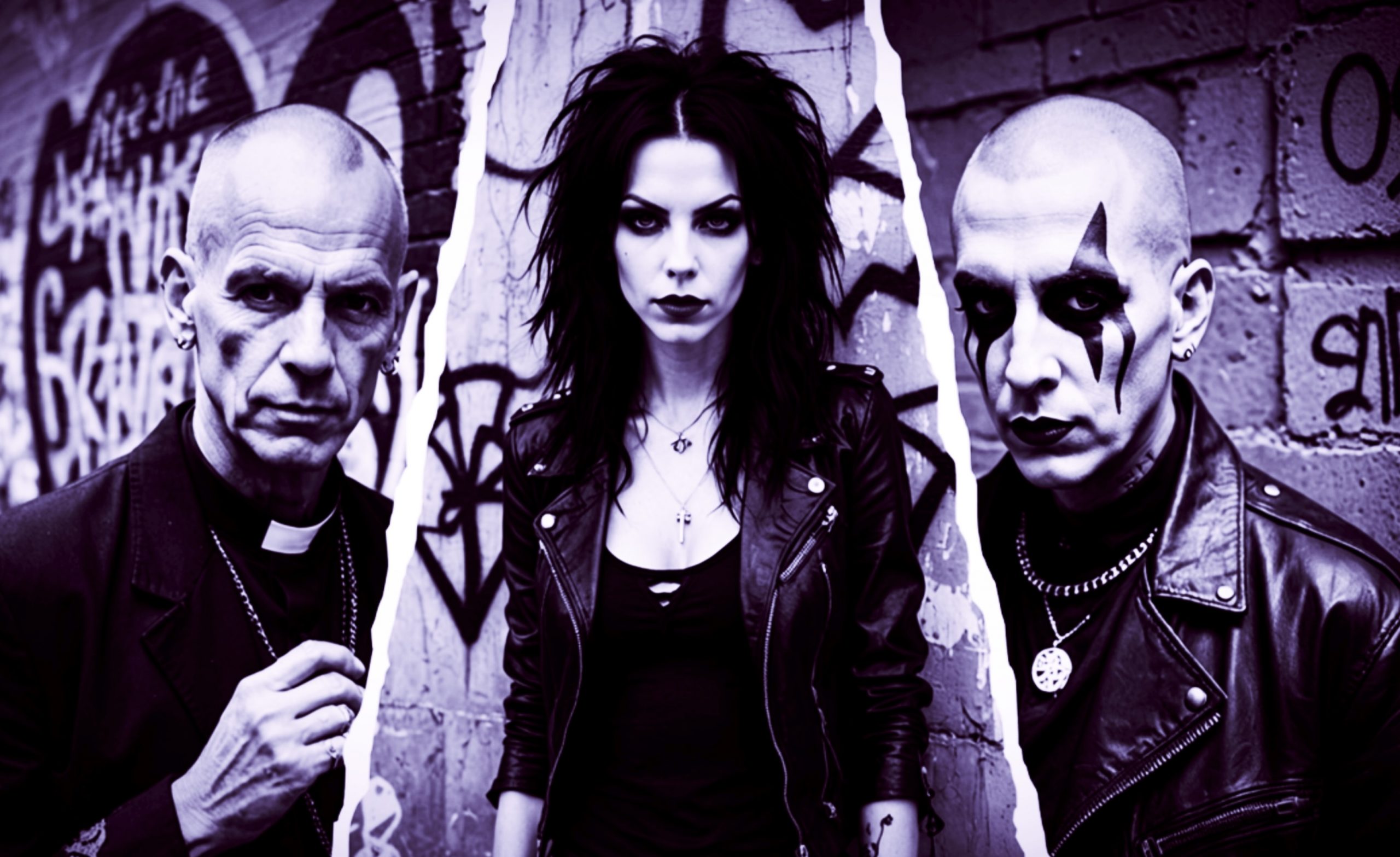
In this week’s 10 Questions we get to know Maira 3, a gothic-industrial band from Berlin, Germany
Their song ‘Bloodletting’ is currently featured on the NAS Spotify playlists
You can follow Maira 3 on Instagram and X (formerly Twitter)

1. Tell us a little about where you are from.
We’re a Berlin-born project, though we’re not all in the same city anymore. Maira still lives in Berlin, Kai is up in Hamburg, and Thomas is in Frankfurt. That distance adds a bit of creative tension—we’re constantly exchanging ideas across cities. We started Maira 3 back in 2021, initially just making ambient soundscapes for art installations and an obscure art film. Now, three albums later, we’ve evolved into something much darker and louder.
Right now, we’ve just wrapped up production on an EP called “Breakables“, a remix-collaboration with Eleanor Collides from London. It’s a more delicate project compared to our last album, “The Turning“, but still very much us. We’re also working on a new set of music videos and planning to start writing our fourth album this fall. Touring isn’t on the table at the moment—life logistics—but creating and releasing is a constant.
2. What inspired Maira 3 to start playing and making music?
It wasn’t about chasing a scene or trying to be a “band” in the traditional sense. It started with a shared fascination for sound and emotion—especially how sound can shape space, movement, and mood. Our roots are in performance art and visual installations. We were experimenting with soundtracks that felt immersive, almost cinematic. You can hear that on our first album “runework“, which was only instrumental, and fairly mellow. Over time, those sound experiments grew teeth.
We reached a point where ambient textures weren’t enough—we needed vocals, rhythms, lyrics. That’s when we felt we really came into our own. We weren’t just scoring moments anymore; we were telling dark stories, asking questions, exploring emotional and auditory extremes.
It wasn’t about chasing a scene or trying to be a “band” in the traditional sense. It started with a shared fascination for sound and emotion
3. Who are Maira 3’s biggest musical influences?
Our influences are pretty wide-ranging, but they all orbit that same emotional gravity. Skinny Puppy and Nine Inch Nails have definitely shaped our industrial backbone—there’s something cathartic in their chaos. Depeche Mode gives us melodic sensibility—Thomas especially is drawn to their ability to make something dark feel beautiful.
Maira draws a lot from Chelsea Wolfe and is currently obsessed with Dead Posey—not just their sound, but the intensity and edginess in their performances. And Kai brings the beat-heavy edge, with nods to old-school punk and new wave. He’s been on a serious Adam and the Ants and Bow Wow Wow kick lately. Somehow it all fuses—beat-driven, synth-heavy, emotionally raw.

4. What are your goals in the music industry or as an artist?
We’re not here to surf on trends or algorithms. Our goal is to carve out a space that feels genuine and emotionally resonant—for ourselves and for the people who find their way to our music. Industrial music might sound cold or harsh on the surface, but it’s incredibly emotional underneath. That tension between machinery and humanity is what drives us.
If someone listens to a song like “Control” or “Bloodletting” and feels seen, or even just compelled to think about something differently, that’s success for us. Ultimately, we’re chasing a sound that’s distinctively “us.” Something you can’t quite place, but immediately recognize when it hits.
5. Tell us about your creative process.
It’s a layered process, almost architectural. We usually start with a bassline—something that sets the emotional tone—and a simple beat. From there, we build. Synth pads give us a harmonic framework, and then we start adding textures: distorted synths, filtered loops, sampled fragments of noise. It gets deconstructed and rebuilt several times before it feels right.
We often record synths through guitar amps or pedals to make them feel more tactile, less pristine. For kicks we even recorded a solo trumpet through a feedback-infested Marshall stack; it sounded like an electric guitar mixed with the cries of a wounded animal—very cool, haunting. Check it out on the track “Hallowed II (The River)”.
The drums evolve from machine rhythms into something more complex, sometimes blending programmed and live elements. Maira’s lyrics and hushed vocals come last—they’re shaped by the atmosphere we’ve built. It’s not linear. It’s more like finding a path through fog.
It’s a layered process, almost architectural. We usually start with a bassline—something that sets the emotional tone—and a simple beat. From there, we build.
6. What is your all-time favorite song by another artist and why?
We’d probably all give you different answers depending on the day. But if we had to settle on one song that encapsulates our collective energy, it might be “Closer” by Nine Inch Nails. It’s provocative, layered, emotional—everything we admire in industrial music. There’s an honesty to it that cuts through all the noise. Maira might say “Feral Love” by Chelsea Wolfe—it’s raw, slow-burning, haunting. It kind of sneaks up on you emotionally. We’re drawn to songs that reveal something deeper the more you listen. Nothing surface-level.

7. What is the best advice you have either given or received in terms of music?
The best advice we’ve received is: “Don’t be afraid to leave it broken.” That came from an engineer of our second album. In the beginning, we’d overwork tracks—trying to make them clean, perfect, polished. But that stripped away the personality, the rawness. Now we try to leave room for rough edges, for things that don’t resolve perfectly. For those happy sound accidents. There’s beauty in the broken.
This applies to lyrics too. Sometimes ambiguity says more than clarity. We don’t spell everything out in our songs—people bring their own meanings, and that’s part of the experience.
Sometimes ambiguity says more than clarity. We don’t spell everything out in our songs—people bring their own meanings, and that’s part of the experience.
8. What is your proudest accomplishment?
“The Turning” felt like a milestone. It was darker, heavier, more ambitious than anything we’d done before. And it landed. People responded to the tension in it, to the emotional weight. “Control” especially seems to have hit a nerve. Getting that kind of response—from listeners, from fellow musicians—was a proud moment for us.
Also, having our “Bloodletting” video age-restricted by YouTube—and banned by Vevo—was unintentionally satisfying. It’s not even that graphic—but something about the way we combined imagery and sound must have hit a little too hard. We’ll take it! We got feedback from friends that the video IS a little disturbing, though…
9. What’s been your most embarrassing moment so far?
There was a show in (…hush my darling, let’s keep it secret)…where Thomas’s entire synth setup glitched out during the set. We were halfway through a track, and suddenly… total silence from his side. He had to pretend (badly!) that he was still playing while Kai scrambled to improvise from the drum kit – for more than 15 minutes!
Somehow the audience thought it was part of the performance. Maybe they expected weirdness. Or perhaps they were just sky high…That’s one benefit of being a gothic-industrial band—people assume the chaos is intentional. Well, lets not disabuse them from that notion!
10. Tell us about your lowest and highest points in music so far.
The lowest point came after we released “runework”. It was our first album, but also a strange one—abstract, ambient, more of a sound experiment. We weren’t sure where to go from there. Should we even continue? It felt like we were in between identities. That’s when we started rethinking everything—our sound, our roles, our intentions.
The high point came with “Toxin” and “Bloodletting”. For us, these tracks felt like the breakthrough—liberating. Sonically, they defined where we wanted to go next, and became the foundation of the album “The Turning” . And the response we got confirmed we weren’t just searching and experimenting anymore—we were starting to build something identifiable and real.
Of course, now the question becomes: where to go next. How to stay true to our identity and sound without repeating ourselves too much. But that will be our next adventure.

Leave a Reply